A new centre adopts the template
Screening days come from templates with time grids, breaks and room sequences. A centre starting operations begins with the day the others already run, instead of building it from scratch.
Read moreMilitary service & screening
Medical assessment, computer-assisted test, interview with the test lead and placement interview in a single day: flynne plans the stations, staffs them and keeps the pace when one of them fails.
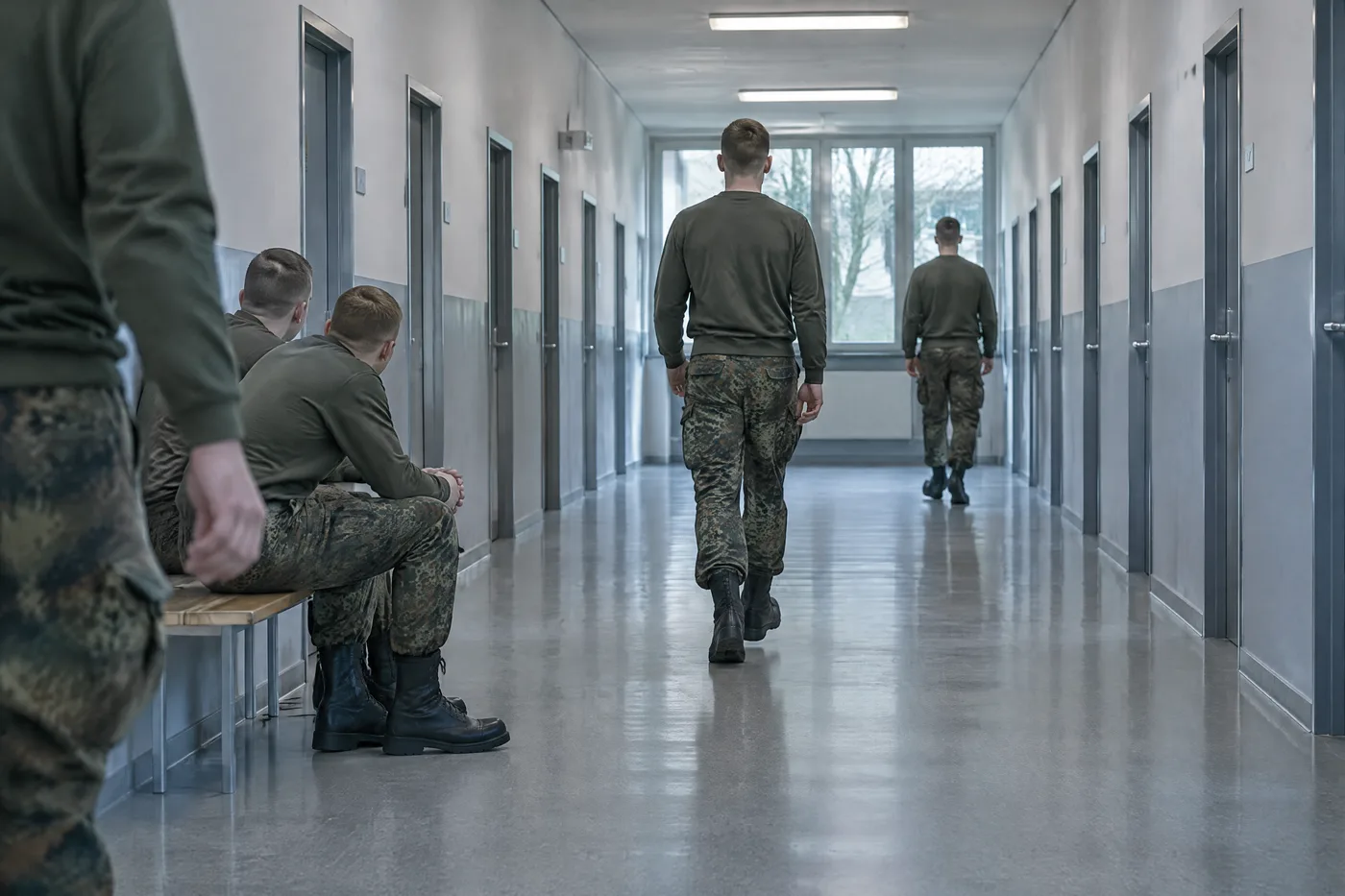
According to the German armed forces, around 350,000 men with German citizenship turn 18 every year, while regional screening centres are still being set up. The number of people called up is therefore fixed; the number of examination places cannot simply be increased. flynne plans locations, rooms and specialists together and shows every gap while it can still be filled.
Assessment, computer-assisted test, interview and placement with their own rooms, roles and times.
Each screening centre plans its own appointments; the central team sees capacity across all of them.
Health data is separated by role-based permissions and every access is logged.
Service description, technical and organisational measures, processing agreement and price sheet on request.
Screening days come from templates with time grids, breaks and room sequences. A centre starting operations begins with the day the others already run, instead of building it from scratch.
Read morePeople called up book or move their appointment themselves through an access link. Anyone who does not respond appears on the disruption list while the place can still be filled again.
Read moreAccess, retention and deletion are recorded per data category. Findings are visible only to the roles allowed to see them.
Read moreThe armed forces describe the day as a sequence of stations that can usually be completed within one day. flynne plans exactly that sequence; it does not carry out the procedures.
Call-up after registration
Whoever is invited confirms or moves the appointment through an access link, without an account and without phone chains.
Medical assessment
Medical capacity is the tightest point of the day and is planned as its own quantity.
Computer-assisted test and interview
Test places, time slots and the test lead are staffed as their own station, with a capped group size.
Assessment board where it is needed
Longer service terms add a board interview, officer career paths add a fitness test elsewhere. flynne plans both as their own stage.
Placement and counselling interview
The day closes with the interview in which the result is communicated. After that flynne hands over to your downstream processes.
Responsibility: BAIUDBw
Commercially available goods and civil services are procured by the Federal Office for Infrastructure, Environmental Protection and Services; armaments and weapon-system-related IT go through the BAAINBw. A scheduling platform falls into the first category. We classify the service under CPV 79635000.
GWB, VgV and UVgO
The estimated net contract value decides whether a tender is national or EU-wide. Notices appear via TED, service.bund.de and evergabe-online.de. Unsolicited offers outside published procedures are not considered: flynne applies within the procedure, not beside it.
Market exploration under § 28 VgV and § 8 UVgO
Before a procedure, the contracting authority may obtain a market overview, without obligation and without any claim to an award. For that purpose we keep a service description, a price sheet and security evidence ready to hand.
Art. 9 GDPR: health data
Findings from the medical assessment are a special category of personal data. flynne separates them through role-based permissions: the medical service sees the finding, counselling only the result it needs for its task.
BITV 2.0: accessibility
Applications run by federal public bodies must be accessible. This applies above all to the interface where people called up confirm or move their appointment.
DIN 33430 and the EU AI Act
Standardised aptitude assessment, and no scoring by AI: the result follows from the findings and the judgement of qualified people. flynne organises the day; it does not assess anyone.
Every role brings its own rules, its own participants and a bottleneck of its own.
Medical assessment
It covers hearing, eyesight, blood pressure, stamina, back and joints, and so sets the pace of the whole day. If a medical professional drops out, every later station shifts. flynne plans this capacity separately and reports the absence before the waiting area fills up.
Test lead for the computer-assisted test
The test needs test places, fixed time slots and a test lead for the interview that follows. Group size is capped and the order relative to the medical assessment is fixed. flynne staffs the station; the test itself comes from the armed forces.
Assessment board
Service terms of two years or more add a board interview, officer career paths a fitness test at another location. Several participants, one appointment: exactly the case where scheduling chains break.
Career centre and counselling
The placement and counselling interview closes the day. It needs the result of the earlier stations, but not the medical findings in detail. flynne separates the two through role-based permissions.
Screening centre management
Responsible for capacity across weeks, not a single day. What must be visible is where places stay empty and where the waiting list grows, early enough to act.
As licensed software (ASP/SaaS) through a regular procurement procedure. For your process we provide a service description, technical and organisational measures, a data processing agreement and a price sheet. The armed forces supplier self-disclosure is on file.
No. Assessment, testing and judgement stay with the armed forces. flynne plans the stations, issues the call-ups, staffs rooms and specialists and solves disruptions on the same day.
In data centres in Germany, under a data processing agreement. Access is logged and retention periods are recorded per data category.
Yes. flynne is multi-tenant: screening centres and career centres use the same installation and the same templates without seeing each other participant data. The central team sees capacity across all of them.
Two to four weeks to the first live procedure, depending on how quickly templates, roles and location data are settled.

Tell us briefly how you run procedures today and we will show you in 30 minutes how flynne helps.
We reply within one working day.