
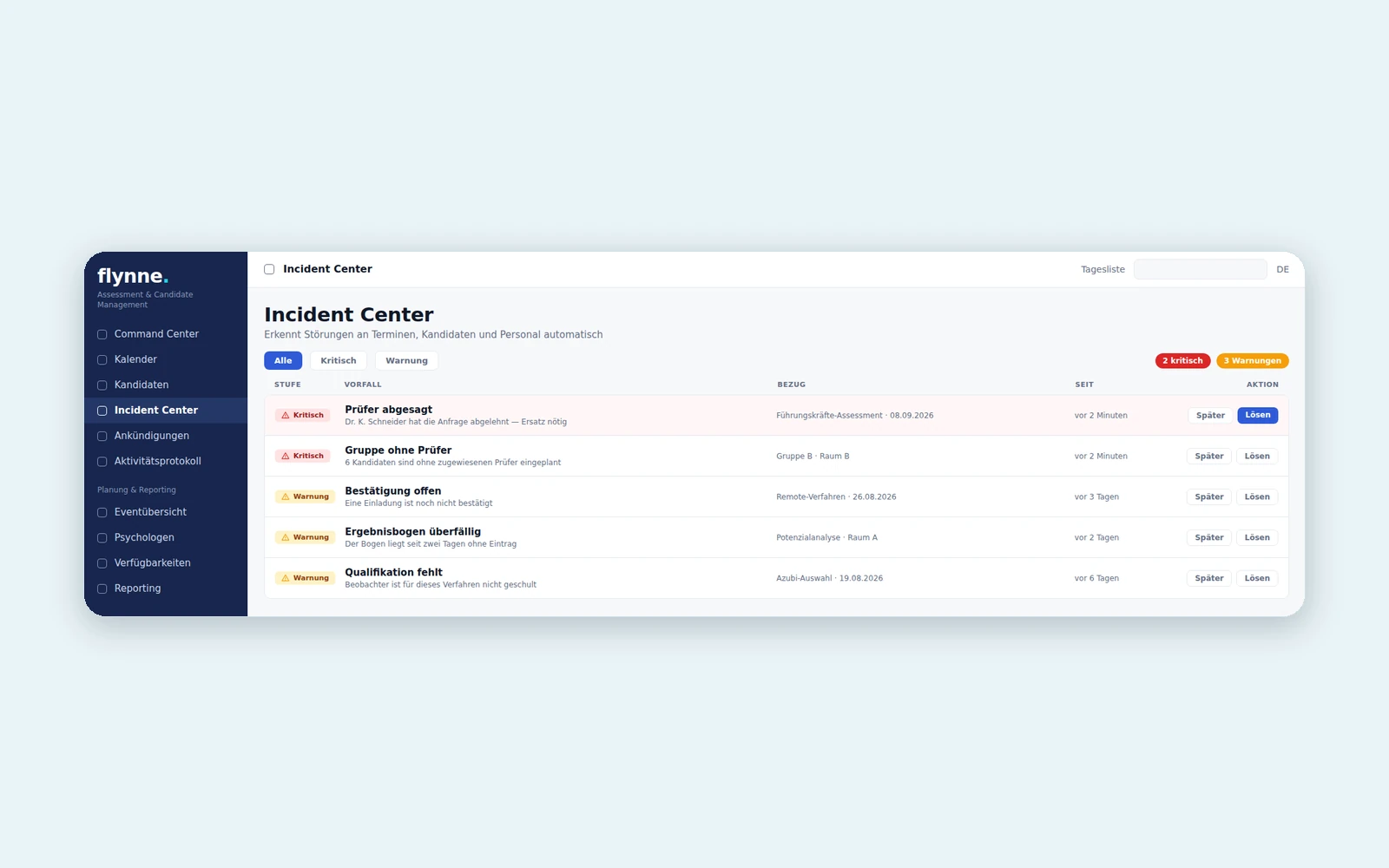
Disruptions in assessment operations are not the exception. In an organisation running several hundred procedures a year they are everyday business: sickness calls, cancelled trains, last-minute withdrawals, a room booked twice.
What is interesting is not that they happen. What is interesting is what happens in the first ninety minutes afterwards. We played the same case through twice.
Version A: spreadsheets and a telephone
6.52 a.m.: a text message to the coordinator: “I am ill, I cannot make it today.” The psychologist was due to run five individual interviews, 9.00 a.m. to 3.30 p.m.
7.15 a.m.: the coordinator reads the message on her way to work. She does not know who else is qualified. The overview is on the shared drive, and not on her phone.
7.40 a.m.: in the office. She opens the availability spreadsheet. Last updated: last week. Three names come into question. For one of them she is not sure whether he is trained for this procedure.
7.48 a.m.: first call. Voicemail.
7.55 a.m.: second call. That colleague is running a procedure of her own at another site today. It was not in the spreadsheet.
8.10 a.m.: third call. He would have time, but the qualification is unclear. A question goes to the head of assessment.
8.25 a.m.: the head of assessment is in a meeting. The coordinator writes an email and waits.
8.30 a.m.: the first candidates arrive. Nobody can tell them whether their interview is going ahead today.
8.52 a.m.: answer from the head of assessment: the qualification is there, but only for the standard procedure, not for the leadership variant. Two of the five interviews are cancelled.
9.05 a.m.: the stand-in starts the first interview without having seen the documents beforehand.
9.20 a.m.: two candidates are asked to go home. A new appointment will be sent “in the next few days”.
Until 11.00 a.m.: the coordinator writes emails: to the two candidates, to the department, to the assessors, to finance about the cancellation rules. In between she answers questions in the room.
Result: two candidates without an interview, a stand-in without preparation, half a working day of coordination, a procedure run under unequal conditions. Afterwards the sequence of events can only be reconstructed from calendars and mailboxes.
Version B: a system that thinks along
6.52 a.m.: the psychologist marks himself unavailable in the portal. One click, no phone call.
6.52 a.m.: the system detects an incident: five sessions without an assigned person, the supervision ratio breached, category “critical” because the date is today. The coordinator and the head of assessment receive a notification.
6.53 a.m.: the incident comes with a proposed solution. It only contains people who are qualified for this variant of the procedure, who are demonstrably available today and who are not scheduled at another site. Two names, with their workload for the current week.
7.15 a.m.: the coordinator reads this on her phone. She picks the first suggestion, checks the prepared notifications and confirms.
7.16 a.m.: the stand-in receives the request together with a calendar invitation, and the documents are released to him. The candidates receive confirmation that their appointment is going ahead. The department sees the updated status.
7.34 a.m.: the stand-in accepts. The incident is closed. All five interviews take place.
8.30 a.m.: the candidates arrive. As far as they are concerned, there was no disruption.
Effort for the coordinator: a few minutes, most of it spent reading the prepared messages. The whole case is documented with time stamps.
Where exactly the difference comes from
The second version is not faster because an AI is cleverer. It is faster because four pieces of information sit in one place that, in version A, sit in four.
Who is qualified? In a matrix attached to the type of procedure, not in an overview on the shared drive.
Who really has time? From self-maintained availability plus every existing assignment, across all sites.
Who is carrying how much? From the operational data, so that it is not always the same people stepping in.
Who needs to be informed? From the roles attached to the procedure, with prepared texts.
If one of those four is missing, telephone work begins. If two are missing, it becomes half a day.
The underrated part
The most important thing is not the speed but what does not happen: in version B there are no candidates standing in front of a closed door. No two interviews held five weeks later under different conditions. No stand-in walking unprepared into an interview.
Those are not efficiency questions. They are quality questions, and in case of doubt questions that a rejected applicant will ask.
And if nobody is available?
Then no system solves the problem. In version B too it can happen that no qualified person has time.
The difference: that is clear at 6.53 a.m., not at 8.52 a.m. Two hours of lead time decide whether candidates can still be told in time, or whether they travel in for nothing.
How disruption management works in flynne, and which conflicts are detected automatically: Disruptions.